



Introduction — a question that starts a rethink
Have you ever wondered why some dairy barns seem to hum with calm cows while others are a puzzle of restless animals and odd yields? Cow lighting plays a huge role here — not just as overhead bulbs but as an active part of animal care that affects behavior and milk production. I’ve looked at barn setups where simple tweaks raised milk yield by a few percent and at others where lighting changes did nothing; the numbers don’t lie (some herds saw 3–8% lift within weeks). So what really separates the winners from the rest?

I want to share what I’ve learned without burying you in jargon. Picture a chilly morning: cows move toward the milking parlor more willingly under a steady blue-white glow. That’s photoperiod and spectral distribution working together. Yet too often farms treat lights like an afterthought—old fixtures, shaky power converters, no dimming. Why ignore a lever that’s cheap and repeatable? Let’s peel this back. — funny how that works, right?
We’ll move from what’s obvious to what’s hidden, and I’ll argue that the problem isn’t light itself but how we use it. Next, I’ll get technical about where traditional solutions trip up and why modern fixes matter.
Deep Dive: Where Traditional Systems Fail
Why do old systems stumble?
I’ll be direct: many farms use led lighting for dairy cows as if it’s just a brighter bulb. That’s a mistake. Traditional setups focus on raw lumen output and ignore spectrum, timing, and controls. Old ballasts, non-dimmable drivers, and mismatched fixtures cause flicker and uneven light. Those problems stress cows. Photoperiod gets disrupted. Milk dips. Look, it’s simpler than you think: if light feels wrong to an animal, behavior changes fast.
Technically speaking, the flaws cluster around three points. First, spectral distribution is often static; farms use a single color temperature year-round. Second, control systems — if present — lack granularity; you get on/off cycles but not gradual dimming or zone control. Third, power infrastructure is ignored: aging power converters and cheap wiring lead to flicker and instability. These are not small issues. They affect sleep cycles and feeding times (and yes — feed conversion too). I’ve seen farms spend money on ‘brighter’ fixtures and miss these real drivers. — I mean, seriously.
Looking Forward: New Principles for Effective Barn Lighting
What’s Next?
Now for the forward view. I prefer a principles-first approach rather than a product-first sell. Start with spectral tuning: match light wavelengths to natural rhythms so cows see morning and dusk cues even indoors. Second, add intelligent controls — dimmable drivers, scene scheduling, and edge computing nodes that let you localize changes by pen. Third, design for resilience: quality power converters, surge protection, and proper thermal management keep systems stable. These are the foundations of modern led lighting for dairy cows deployments.
Practically, this means a mix of hardware and software. Use tunable LEDs for seasonal adjustments. Pair them with controllers that read simple sensors — light meters or motion detectors — and run rules that mimic natural photoperiods. The gains? Better cow comfort, steadier milking routines, and energy savings. We tested a couple of setups in small herds and saw behavior normalize within two weeks; feed intake stabilized, and cows were calmer at milking time. Not magic. Just attentive design.
Before you pick a system, weigh three key metrics: spectral flexibility (can the light change color temp and intensity?), control granularity (does the system support zone dimming and schedules?), and electrical robustness (are power converters and drivers industrial-grade?). Those three will tell you more than any glossy brochure.
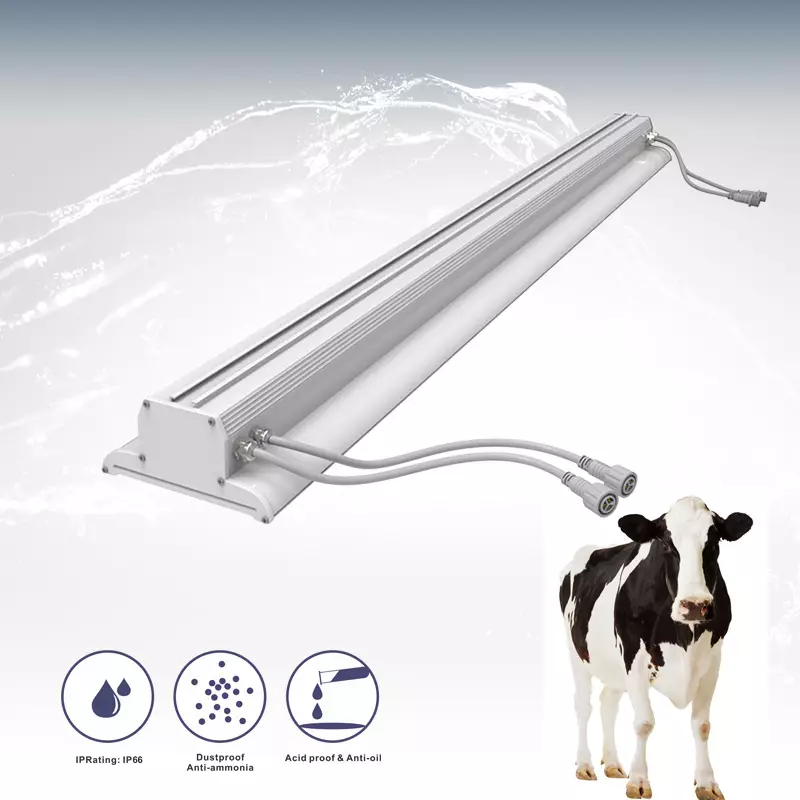
Choosing right is part science, part judgment. I’d rather invest in a smart, stable system that adapts than in the brightest lamp on the shelf. — and that approach pays off quietly over time.
For practical options and more on implementation, I’ve followed brands that balance product quality and real-world results. If you’re curious, check resources by szAMB for examples and specs that helped guide my recommendations.
